Contamination Below the Surface: Understanding and Combating Lubricant Degradation in Deep Shaft Mining
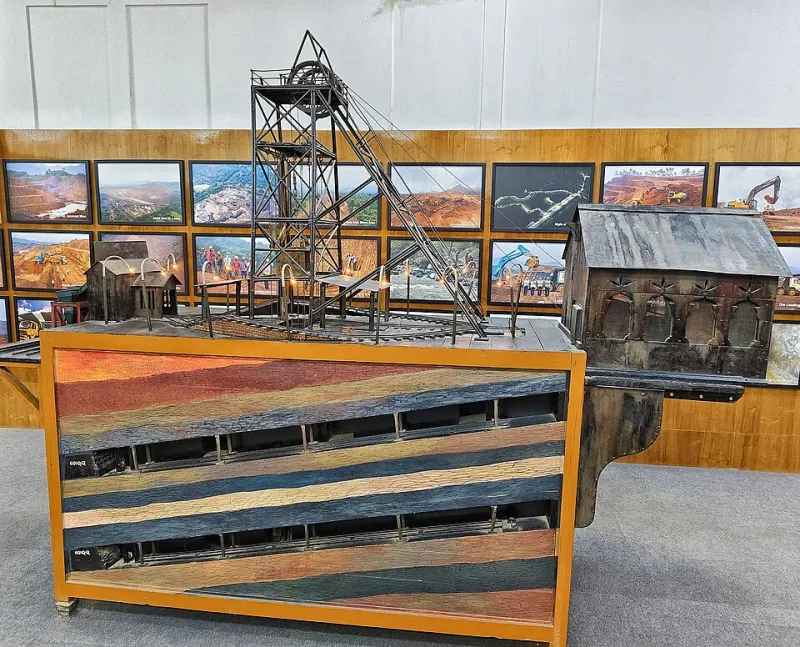
Photo: Aliva Sahoo, CC BY-SA 4.0, via Wikimedia Commons
The Underground Environment Is Not Like Anything Else
Surface mining presents its own lubrication challenges—temperature extremes, dust loading, heavy shock loads. But the underground mining environment introduces a set of degradation vectors that are qualitatively different, and in several respects more difficult to manage.
Deep shaft operations in the United States—whether in the hardrock gold and silver mines of Nevada and Idaho, the deep coal mines of Kentucky and West Virginia, or the potash and trona operations of the intermountain West—share a common environmental profile: high relative humidity approaching saturation, ambient temperatures elevated by geothermal gradient, continuous fine particulate generation from drilling and blasting, and the near-total absence of the natural air circulation that helps manage contamination on surface equipment.
In these conditions, lubricants do not simply wear out—they are actively attacked. Understanding the specific mechanisms of that attack is the starting point for any serious contamination management program.
Mechanism One: Moisture Ingress and Emulsification
Water is the most pervasive contaminant in underground mining lubricants, and it enters equipment through multiple pathways simultaneously. Condensation forms on cool metal surfaces when warm, moisture-laden mine air contacts them. Water-based rock cooling systems and dust suppression sprays introduce liquid water directly into the equipment operating environment. And in mines that intersect water-bearing geological formations, groundwater infiltration can be substantial.
Once water enters a lubricant system—whether a gearbox, hydraulic circuit, or bearing housing—it initiates a cascade of degradation processes. At concentrations as low as 0.1 percent by volume, water begins to compromise the lubricant film that separates metal surfaces under load. The lubricant's additive package, which typically includes anti-wear agents, rust inhibitors, and oxidation stabilizers, is progressively depleted as these additives preferentially react with or are carried away by the water phase.
In hydraulic systems, water contamination accelerates the corrosion of precision-machined valve components and pump internals, where dimensional tolerances are measured in microns. A hydraulic pump operating on emulsified fluid—where water has been mechanically blended into the oil—experiences accelerated cavitation, elevated operating temperatures, and dramatically shortened service life.
The diagnostic signature of water contamination is well-established: milky or hazy fluid appearance in more severe cases, elevated neutralization number from hydrolysis of additive components, and the presence of rust particles in oil analysis samples. What is less well understood in many operations is how rapidly these conditions develop in deep underground environments—often within weeks of a fresh fluid charge in a poorly sealed system.
Mechanism Two: Particulate Contamination and Abrasive Wear
Underground mining generates fine rock dust continuously. Drilling, blasting, mucking, and conveying operations all introduce silica-bearing particulates into the mine atmosphere. In confined underground headings and drifts, airborne particle concentrations can be orders of magnitude higher than in open-pit or surface operations.
Equipment seals in underground mining machinery are subjected to constant assault from this particulate loading. When seal integrity is compromised—as it frequently is in equipment that operates under the mechanical stresses and physical impacts common in underground mining—fine abrasive particles enter lubricant systems.
The consequences are predictable but severe. Silica particles in the two to ten micron size range—too small to be caught by many standard filtration systems, but large enough to cause significant surface damage—act as a grinding compound within gear meshes, bearing raceways, and hydraulic component clearances. Wear rates in contaminated systems can be five to ten times higher than in clean systems running equivalent loads.
Particle counting via ISO 4406 cleanliness coding has become a standard tool in sophisticated underground maintenance programs, and the target cleanliness levels for hydraulic systems in underground equipment are demanding—typically ISO 16/14/11 or cleaner for sensitive proportional valve systems. Achieving and maintaining those targets in a deep underground environment requires both high-efficiency filtration and lubricants formulated to suspend and deliver particles to filtration points rather than allowing them to settle and concentrate in critical zones.
Mechanism Three: Microbial Colonization
The third contamination pathway is the least visible and, for many maintenance personnel, the most surprising: biological degradation of lubricants by microorganisms.
The combination of water, hydrocarbon nutrients, moderate temperatures, and near-darkness in deep underground environments creates conditions that are, from a microbiological perspective, remarkably hospitable. Sulfate-reducing bacteria, in particular, thrive in the anaerobic conditions found in the water bottoms of hydraulic reservoirs and gearbox sumps. These organisms metabolize lubricant components and produce hydrogen sulfide and organic acids as byproducts—both of which are corrosive to metal components and destructive to additive packages.
Fungal contamination, while less common, has been documented in underground mining lubricant systems, particularly in water-glycol hydraulic fluids used in fire-resistant applications. Fungal growth produces visible biomass—often described as a dark, fibrous sludge—that can physically block filters and narrow-clearance flow passages.
Detection relies on microbiological dip-slide testing of fluid samples, which provides a colony-forming unit count within 48 hours. Treatment options include biocide addition to the fluid charge, but the more durable solution is eliminating the water accumulation that creates the conditions for colonization in the first place.
Engineering Responses: Filtration, Monitoring, and Fluid Selection
A comprehensive contamination management program for deep underground equipment operates on three parallel tracks.
Advanced filtration: High-efficiency kidney loop filtration systems—operating continuously on hydraulic reservoirs independent of the main hydraulic circuit—have become standard practice in well-managed underground operations. Beta ratio filtration media rated at β10(c) ≥ 200 provides effective removal of the particle sizes most damaging to hydraulic components. Desiccant breather filters on reservoir vent ports address the moisture ingress pathway during thermal cycling.
Condition monitoring: Regular oil analysis—minimum quarterly, monthly for high-criticality equipment—provides early warning of contamination trends before they reach damaging concentrations. Elemental spectroscopy identifies wear metal accumulation; Karl Fischer titration measures water content with precision; particle counting quantifies cleanliness levels. The investment in systematic oil analysis programs consistently returns multiples of its cost in avoided component failures.
Specialized fluid formulation: The third element is fluid selection itself. Lubricants formulated specifically for underground mining applications incorporate additive systems designed to resist water washout, maintain film strength in the presence of moderate contamination, and inhibit microbial growth. The demulsibility characteristics of the base formulation—its ability to release entrained water to the reservoir bottom where it can be drained—are particularly important in underground hydraulic applications.
Konya Madeni Yağ's industrial lubricant formulations developed for underground and deep shaft applications are engineered with precisely these operating conditions in mind. The Turkish industrial lubricant sector has long served mining operations in geologically complex environments, and the technical knowledge embedded in those formulations reflects operational experience relevant to the challenges US underground operators face.
Practical Recommendations for Underground Maintenance Teams
For maintenance supervisors managing underground equipment fleets, the contamination challenge is manageable with disciplined practice:
- Establish sealed fluid transfer protocols that prevent atmospheric contamination during top-up operations
- Specify and verify reservoir drain intervals to remove water bottoms before microbial populations establish
- Audit seal condition as a scheduled maintenance item, not a reactive response to visible leakage
- Implement oil analysis as a predictive maintenance tool, not merely a post-failure diagnostic
- Evaluate fluid specifications against the actual underground environment rather than defaulting to the lowest-cost product meeting minimum OEM requirements
The cost of contamination management is modest relative to the cost of the equipment failures it prevents. In deep shaft mining, where getting replacement components to the point of failure can require hours of shaft travel and rigging, that prevention value is amplified considerably. The lubricant is rarely the largest line item in an underground maintenance budget—but it is frequently the variable most directly connected to whether that budget is met or exceeded.