Out of Sight, Out of Service: The Hidden Cost of Poor Lubricant Storage in US Mining Operations
There is a persistent assumption in mining operations management that equipment sitting idle is equipment that is resting — conserving itself, ready to perform at full capacity the moment it is called upon. This assumption, while intuitive, is dangerously incomplete. For many US mine operators, the most consequential machinery failures are not triggered by excessive load, harsh terrain, or operator error. They are triggered by what happened inside a sealed drum in a corner of the warehouse three months before the machine ever turned over.
Lubricant degradation during storage is one of the least discussed yet most financially damaging vulnerabilities in American mining operations. It is a problem that unfolds in the dark, without warning signals, and reveals itself only at the worst possible moment — when a piece of equipment that was supposed to be deployment-ready fails within hours of being put to work.
The Chemistry of Quiet Deterioration
To understand why stored lubricants fail, it is necessary to understand what lubricants are made of and how they respond to environmental stressors over time. Modern industrial lubricants — whether mineral-based or synthetic — are complex formulations consisting of base oils and additive packages. These additives perform specific functions: they inhibit oxidation, neutralize acids, reduce foam, prevent rust, and maintain viscosity stability under pressure and heat.
The critical detail that many operations managers overlook is that these additives begin degrading the moment the lubricant is manufactured. Oxidation, the primary mechanism of lubricant breakdown, does not require elevated temperatures or mechanical stress to proceed. It requires only one thing: time in the presence of oxygen. Even a sealed drum stored at ambient temperature will experience gradual oxidative degradation, particularly if storage conditions fluctuate.
Temperature cycling — the repeated expansion and contraction caused by daily and seasonal temperature swings — is especially destructive. As temperatures rise, the air inside a partially filled drum expands and pushes out through imperfect seals. As temperatures fall, that same drum draws in ambient air, which carries moisture and oxygen directly into contact with the lubricant. Over weeks and months, this breathing effect introduces contamination that no amount of drum-sealing can fully prevent.
The Warehouse as a Risk Zone
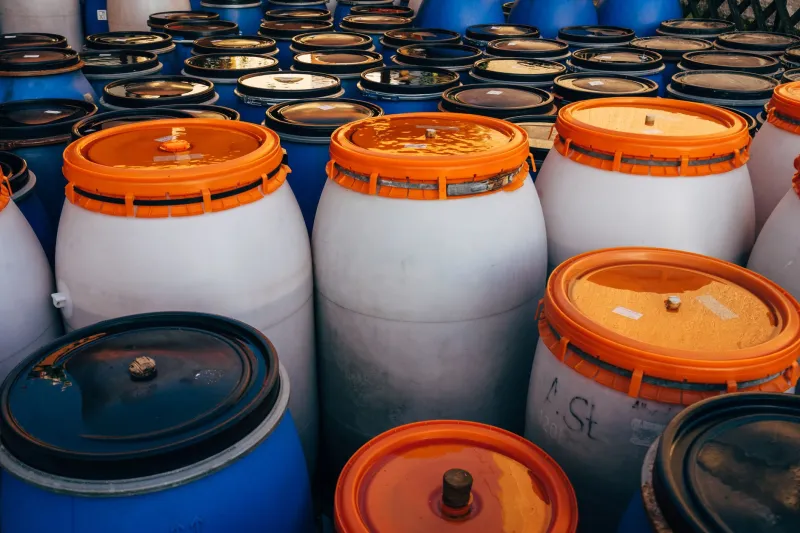
Many US mining operations store lubricants in conditions that would not pass basic inspection if examined critically. Outdoor drum storage exposed to direct sunlight accelerates thermal degradation. Drums stored horizontally allow moisture to pool against the bung seal, increasing ingress risk. Lubricants stored near heat sources — compressors, furnaces, or even sun-exposed metal walls in desert-region facilities — experience accelerated viscosity breakdown. In cold-climate operations from Wyoming to northern Minnesota, lubricants stored in unheated spaces can experience wax crystallization that permanently alters their flow characteristics.
Perhaps most concerning is the common practice of storing lubricants without first-in, first-out (FIFO) discipline. In operations where lubricant inventory is managed informally, newer drums are frequently placed in front of older stock for convenience. The result is that older lubricants — already approaching or exceeding their recommended shelf life — remain in storage indefinitely, accumulating degradation while appearing, to any casual inspection, completely serviceable.
Case Studies from the Field
The consequences of these practices are not theoretical. A copper mining operation in the southwestern United States discovered, following an investigation into a series of hydraulic pump failures, that the hydraulic fluid being used had been in storage for over 26 months — well beyond the manufacturer's recommended shelf life of 12 to 18 months. Laboratory analysis confirmed that the fluid's anti-wear additive package had depleted to the point where it offered no meaningful protection under operating conditions. The pumps had not failed because of demanding service. They had failed before demanding service had even begun.
In a separate incident at a coal preparation facility in Appalachia, maintenance crews investigating a pattern of premature gearbox wear found that the gear oil in use had been drawn from drums stored outdoors through a full summer-to-winter seasonal cycle. Viscosity testing revealed that the oil had thickened beyond its rated grade, contributing to inadequate film formation at operating temperatures. The gearboxes had been lubricated — but not effectively lubricated.
These cases share a common thread: the lubricant was present, it was applied in the correct quantity, and it appeared normal to visual inspection. The failure was invisible until it was expensive.
Establishing Storage Standards That Protect Investment
The solution to storage-related lubricant degradation is not complicated, but it does require deliberate implementation. Several practices, when applied consistently, substantially extend lubricant integrity and protect the equipment that depends on it.
Controlled storage environments are the most impactful intervention. Lubricants should be stored in temperature-stable, enclosed facilities where ambient conditions remain within the range of 50°F to 80°F. Where climate-controlled storage is not feasible, insulated enclosures that buffer against extreme temperature swings represent a practical alternative.
Vertical drum storage with sealed bungs facing inward minimizes the surface area exposed to potential moisture ingress and reduces the breathing effect caused by pressure differentials. Drums should be stored on pallets or racks that prevent direct ground contact, which can introduce both moisture and physical damage.
FIFO inventory management must be formalized, not assumed. A simple tagging system that records receipt dates and calculates projected shelf-life expiration is sufficient for most operations. Digital inventory systems that flag aging stock before it becomes a liability are increasingly affordable and widely available.
Periodic sampling and analysis of stored lubricants — particularly those approaching the 12-month threshold — provides an objective measure of product integrity that visual inspection cannot replicate. Routine oil analysis is well-established as a diagnostic tool for in-service lubricants; applying the same discipline to stored inventory is a logical and cost-effective extension of that practice.
Supplier Accountability and Product Traceability
The quality of lubricants entering storage is equally important as the conditions in which they are kept. Sourcing from suppliers who provide documented production dates, batch traceability, and clear shelf-life guidance is a foundational requirement that is sometimes compromised in favor of price or convenience. At Konya Madeni Yağ, every product supplied to international markets — including the US mining sector — carries full batch documentation and storage guidance calibrated to the conditions common in American industrial environments.
This level of traceability matters because degradation begins at the point of manufacture, not at the point of use. Knowing when a lubricant was produced, how it was handled during transit, and what storage conditions it has been exposed to is the only reliable basis for making confident deployment decisions.
The Operational Discipline That Protects the Bottom Line
Mining operations in the United States operate under significant financial and regulatory pressure. Equipment uptime is not merely a performance metric — it is a direct determinant of profitability, safety compliance, and project timelines. The margin for avoidable failure is narrow.
Storage-related lubricant degradation is an avoidable failure. It requires no new technology, no capital investment in equipment, and no specialized expertise to address. It requires only the recognition that a sealed drum is not a guarantee of product integrity, and that the responsibility for maintaining lubricant quality extends from the point of manufacture all the way to the moment of application.
The machines waiting in your equipment yard are not simply resting. They are waiting to perform exactly as well as the lubricants inside them will allow. What happens in that warehouse matters.