Reading the Hardware: What a Haul Truck Axle Teardown Reveals About Lubrication Discipline

Photo: Stahlwille, Copyrighted free use, via Wikimedia Commons
Every maintenance planner in the American mining sector has stood over a stripped bolt and wondered what went wrong. The answer, more often than expected, is not the fastener itself — it is the lubrication program running quietly in the background, or failing to.
Fasteners are honest. They do not benefit from optimistic work orders or incomplete inspection logs. When a bearing starves, when grease is over-applied, or when contamination creeps into a wheel end, the bolts holding the assembly together record the evidence. Learning to read that evidence turns a routine teardown into a diagnostic exercise — one that can flag systemic lubrication problems across an entire fleet.
A Teardown Worth Walking Through
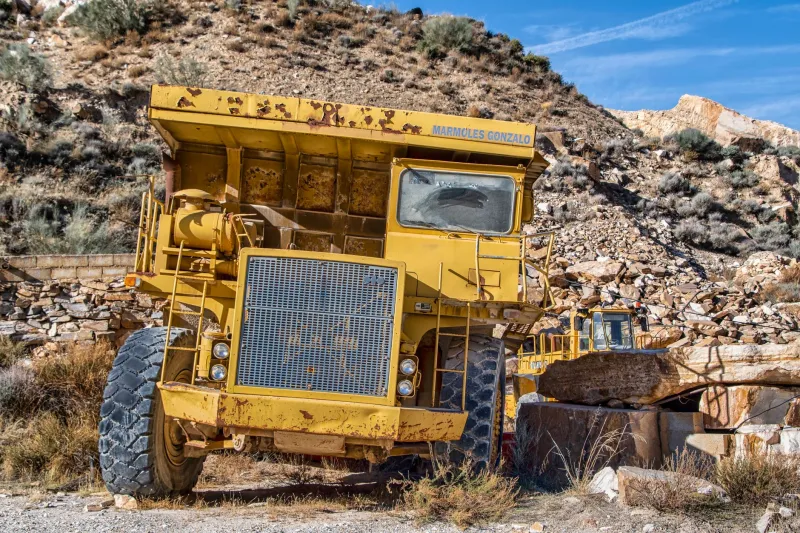
Consider a representative case: a 793-class haul truck at a surface operation in the American Southwest rolls into the shop with rear axle endplay and a suspected wheel-end failure. The teardown proceeds as usual — until the crew reaches the spindle nuts and hub bolts.
The findings follow a familiar pattern.
Under-lubrication. On the outboard side, half of the hub bolts show galling on the threads and a dull, heat-discolored shank. As the bearing assembly ran hot from grease starvation, thermal expansion put cyclic loads on the fasteners. Torque check values on the surviving bolts came in 15 to 20 percent below specification — the classic signature of a joint that has loosened through repeated thermal cycling, not through improper initial installation.
Over-lubrication. On the inboard side, the story inverts. Excess grease had been pumped into the cavity until it purged past the seals. Hydraulic pressure from the grease forced the bearing cage out of alignment, which let the inner race walk. The bolts here show brinelling on the flange faces — dented bearing seats caused by vibration transmitted through a loosened assembly. A few threads are stretched past yield, evidence that someone compensated for a dragging bearing by adding more torque rather than finding the root cause.
Contamination. Silica dust, an unavoidable fact of life in open-pit operations, had migrated past compromised seals and turned the residual lubricant into an effective grinding paste. The telltale here is abrasive scoring on the bolt shanks and a gray, pasty residue in the threads — a fingerprint that points directly at a storage and application problem rather than a product problem.
Why Torque Data Is a Lubrication Metric
Most mines track grease consumption, oil analysis results, and thermographic readings. Far fewer track fastener torque data as a trend line. That is a missed opportunity.
When torque verification readings drift downward across successive inspections on the same component family, the joint is moving — and joints move for reasons. Insufficient lubricant film increases friction at the bearing, which increases temperature, which accelerates fastener relaxation. Over time, the pattern becomes visible in the numbers before it becomes visible in a failure.
Conversely, crews who repeatedly exceed torque specifications "to make it hold" are often masking a lubrication-driven problem. A torque wrench readout that keeps climbing on the same assembly is not a triumph of diligence; it is a symptom being managed instead of solved.
The Signatures to Know
Maintenance teams new to fastener forensics should look for these indicators during teardowns:
- Galling and thread scoring — frequently tied to inadequate lubrication of the fastener itself or extreme heat in the assembly.
- Heat discoloration (blue or straw tones) — direct evidence the joint operated above design temperature, often a lubrication starvation indicator.
- Brinelled flange faces — vibration and impact loading, commonly downstream of a bearing failure caused by grease quality or quantity issues.
- Stretched or necked threads — over-torquing, frequently a workaround for an underlying mechanical problem.
- Abrasive paste in threads — dust or water ingress, pointing to seal failures and contaminated lubricant pathways.
- Inconsistent torque readings across a bolt circle — uneven loading that often traces back to a deformed or misaligned assembly caused by bearing distress.
A Checklist for Adding Fastener Forensics to Routine Inspections
Integrating this discipline does not require new equipment — only new habits:
- Record torque verification values at every wheel-end and driveline inspection, not just at failure. Trend them per component.
- Photograph bolt condition during teardowns. A phone camera and a shared drive cost nothing and build a fleet-wide reference library over time.
- Flag any fastener reused after heat discoloration. Its mechanical properties are compromised, and its history is diagnostic gold.
- Correlate findings with grease logs. If torque drift clusters on machines served by a particular lube truck, shift, or technician, the root cause is procedural, not mechanical.
- Audit torque wrench calibration quarterly. A wrench that reads 10 percent low produces a fleet of over-torqued, pre-stretched bolts — and a misleading data set.
- Review findings at the monthly reliability meeting. Fastener data belongs on the same slide as oil analysis and vibration trends.
From One Axle to a Fleet-Wide Early Warning
The haul truck in our example did not fail because of one bad bolt. It failed because a lubrication lapse went undetected long enough to alter the physics of the assembly — and the bolts were the only components honest enough to say so.
For US mine operators facing pressure to extend component life and reduce unplanned downtime, fastener forensics offers a low-cost, high-signal addition to existing reliability programs. The hardware is already on the machine. The data is already in the wrench. The only missing element is the habit of writing it down.
The next teardown on your site will tell a story. The question is whether anyone will be taking notes.