Grease Under the Fingernails: The Case for Keeping Hands On as Machines Get Smarter
Walk through any newly modernized mine maintenance shop in Nevada or West Virginia and you'll notice the same transformation: wall-mounted dashboards streaming vibration data, cloud-connected sensors reporting oil condition in real time, and predictive analytics software promising to flag failures weeks before they occur. It's genuinely impressive technology, and at Konya Madeni Yağ, we supply lubricants to operations that depend on it.
But somewhere in the enthusiasm for dashboards and algorithms, a quiet devaluation has taken place — one that experienced mine operators are only beginning to recognize. The technician with the grease gun is being treated as a relic, when in truth, that person remains the single most valuable asset in any lubrication program.
What the Sensor Can't Smell
Oil analysis labs and inline sensors are remarkable diagnostic tools. They detect particle counts, water content, viscosity drift, and additive depletion with precision no human hand could match. Yet there are failure modes that no current sensor array reliably catches in time.
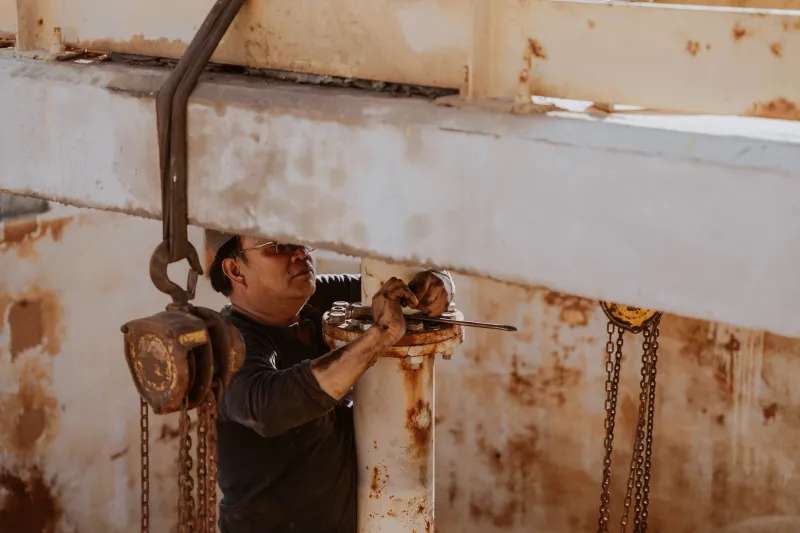
A technician who walks a haul truck bay every morning notices things: the faint burnt odor of a bearing running hot, grease that has changed color at a fitting, a seal weeping just enough to leave a telltale streak on the housing, a grease nipple clogged with the particular red dust common to open-pit operations in the American Southwest. These observations live in the judgment of a person, not in a data stream.
The industry's own reliability literature acknowledges this. Studies repeatedly show that a large share of bearing failures trace back to lubrication errors — wrong product, wrong quantity, wrong interval, wrong application method. Sensors can tell you a bearing is degrading. Only a trained hand applying the right grease correctly can prevent the degradation from starting.
The Craft Being Lost
Here is the uncomfortable reality many US mining operations now face: the workforce that understood lubrication as a craft is retiring. The mechanic who could identify a grease by texture, who knew that a certain gearbox in a certain shovel ran better on a slightly different interval in winter, is walking out the door — and the institutional knowledge is leaving with them.
Compounding the problem, younger technicians are often trained to trust the dashboard and treat manual lubrication as a low-skill task to be rushed between higher-priority jobs. The result is a generation of maintenance staff who can read a trend line but cannot feel whether a grease gun is delivering under pressure or spot the subtle discoloration that precedes a costly failure.
Operations that treat lubrication as an unskilled chore consistently pay for it in unplanned downtime. Those that treat it as a skilled trade — with certification, mentorship, and pride of work — consistently outperform on equipment availability.
Where Modern Formulations Meet Field Judgment
None of this is an argument against technology. It is an argument for pairing technology with the right materials and the right people.
Modern lubricant chemistry has advanced enormously. Formulations engineered for the demands of mining — extreme-pressure greases that cling to heavily loaded bearings, hydraulic fluids with superior water-separation characteristics, products stable across the temperature swings of a high-desert pit — give technicians better tools than their predecessors ever had. Sourced from established manufacturing regions like Konya, Turkey, these products deliver laboratory-grade consistency at a cost structure that makes disciplined, scheduled lubrication economically sustainable.
But even the finest formulation fails if it is applied incorrectly. A premium EP grease pumped into an over-greased bearing generates as much heat as it dissipates. A mixed-product cross-contamination can undo months of careful conditioning monitoring in a single fitting. The value of quality lubricant is only realized through skilled application — which brings us back to the human hand.
Building a Program That Respects Both
For US mine operators looking to balance the old and the new, the practical steps are straightforward:
- Formalize the craft. Establish lubrication technician roles with defined training paths, certification standards, and career progression — not floating duties assigned to whoever is available.
- Pair data with walkthroughs. Use sensor alerts to direct human inspection, not replace it. Every automated flag should end with eyes and hands on the machine.
- Document tribal knowledge. Before senior mechanics retire, capture their machine-specific judgment in lubrication schedules and route notes.
- Standardize products. Consolidating on a small set of well-understood, high-quality lubricants reduces cross-contamination risk and makes both human and machine diagnostics more reliable.
- Invest in quality applicators. Calibrated grease guns, metered dispensing equipment, and clean storage signal that lubrication is skilled work worth doing right.
The Bottom Line
Predictive maintenance technology will keep improving, and mines that ignore it will fall behind. But the operations that achieve the best equipment availability in the decade ahead will not be the ones with the most sensors — they will be the ones where sophisticated monitoring works in partnership with technicians who understand machines at the level of touch, smell, and hard-won experience.
The grease gun is not a museum piece. In the right hands, backed by the right lubricants, it remains the most important reliability tool on the site.